

The shoulder problems people come to us with
The shoulder is the most mobile joint in the body, and several different things can make it hurt. Where the pain sits, what it stops you doing, and whether it started with an injury or crept up on you all point in different directions. The first appointment is spent working out which of these it is, or whether it is something else.
A shoulder that has gone stiff
It hurt first, and then it started to seize up. Reaching behind your back, putting a coat on or fastening a bra becomes difficult, and it is not only pain stopping you: the movement itself is not there. It is often worse at night and you cannot lie on that side. This is what people mean by a frozen shoulder, and it usually arrives without any injury at all.
Pain reaching up, out or behind you
A catching pain partway through lifting the arm, reaching a high shelf, drying your hair or getting something off the back seat of the car. It can ache down the outside of the upper arm, and it often wakes you. This is usually the rotator cuff, the group of tendons that sit at the top of the shoulder and hold it steady while you move it.
Pain on the top of the shoulder or at the collarbone
Two small joints sit at either end of the collarbone: the AC joint on top of the shoulder, and the SC joint where the collarbone meets the breastbone. Both can be sprained by a fall onto the shoulder or a knock in sport, and both tend to hurt when you reach across your body or lie on that side. The pain is usually easy to point at with one finger.
A shoulder that has been injured, or feels unstable
A fall, a tackle, a heavy lift, or a shoulder that has come out of joint before and now feels as though it might again in certain positions. What matters here is working out what was damaged and how much, what needs protecting, and what needs building back up before you return to whatever you did to it.
What happens at your first appointment
The first appointment is fifty minutes, with a chartered physiotherapist, in a private room.
- The story first. When it started, whether anything set it off, where exactly it hurts, how you are sleeping, and what you cannot do at the moment that you want to be doing: work, driving, swimming, lifting a grandchild, reaching a seatbelt.
- Watching the shoulder move. Lifting the arm forwards and out to the side, reaching behind your back, and the same movements with a little help. How far it goes, where it catches, and whether the stiffness is yours or the joint’s is most of the diagnosis.
- Testing it properly. Strength of the cuff tendons in the positions that load them, the two collarbone joints, the neck, and the shoulder blade. Neck problems refer pain into the shoulder often enough that it is always checked.
- A plain explanation and a plan. What we think is going on, in words that make sense, what we suggest doing about it, and what you can do at home. You leave with exercises, not just an appointment card.
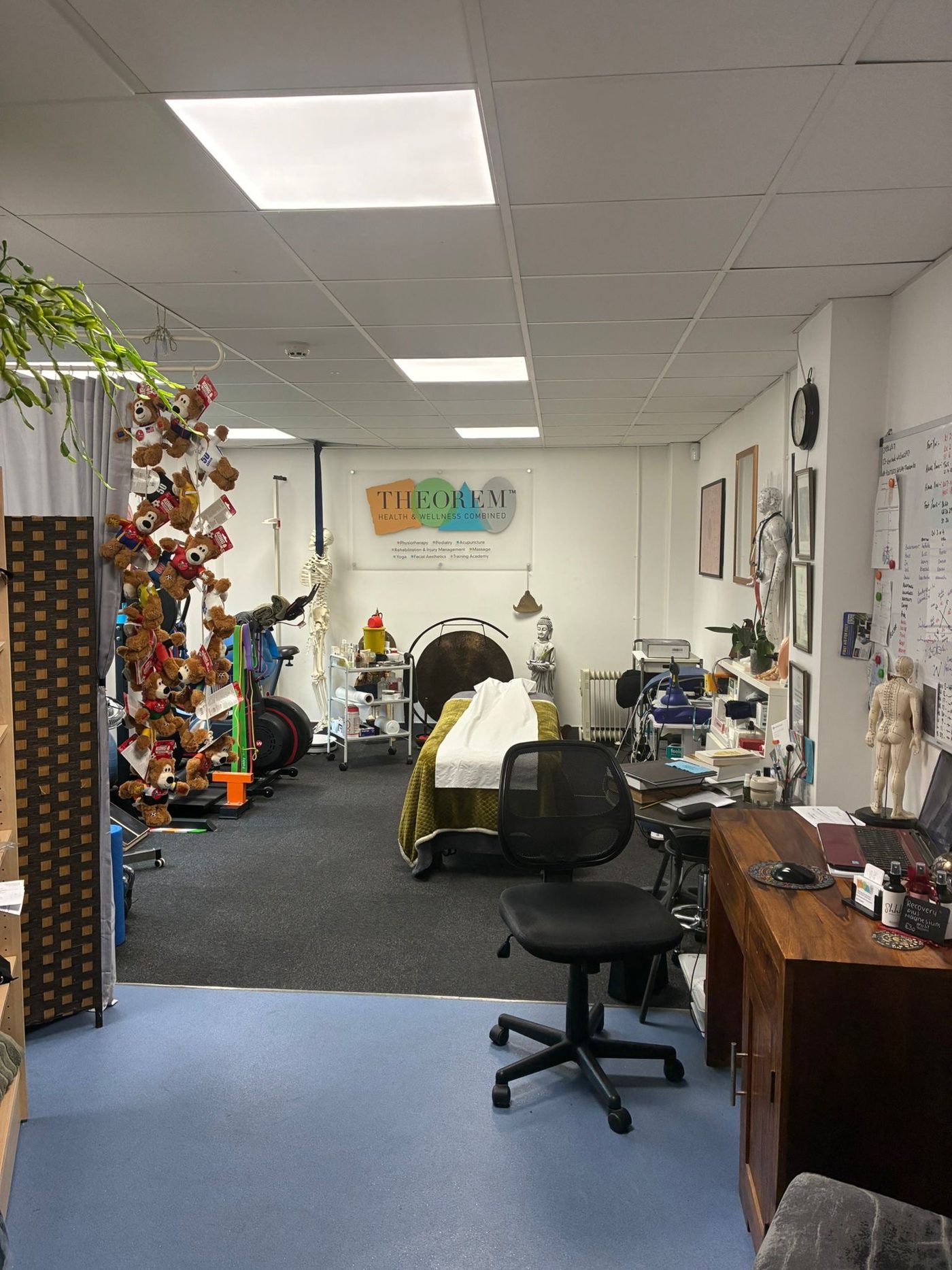
The treatment room at Alcester.
What the plan might include
For most shoulder problems, exercise is the main part of it. Not general exercise, and not a photocopied sheet: specific loading of the tendons and the muscles around the shoulder blade, at a level the shoulder will tolerate, changed as it gets easier. That is slow work compared with a treatment done to you, and it is the part that holds.
A stiff shoulder needs something different from a painful cuff. With a frozen shoulder, a lot of the job is keeping what movement you have, getting the pain under control so you can sleep, and being honest with you about the time it takes. With a cuff problem, the job is usually loading it back up. Telling those two apart is the reason for the assessment.
Alongside that, depending on what we find: hands-on treatment to get movement going, acupuncture, advice on what to keep doing and what to ease off, and, for some people, a joint injection. Everything is in the same clinic, so moving from one to another does not mean a new referral or another waiting list.
What we will not do: promise you a number of sessions before we have seen your shoulder, or sell you a support, a brace or a machine to take home. If your shoulder is not changing the way we expected, we will say so and change the plan, or send you on to someone who should see it.
When a shoulder injection is worth talking about
Some shoulders are too painful to do the exercise that would help them, or too painful to sleep. A frozen shoulder in its painful stage is the clearest example. A corticosteroid injection is one way to settle that down enough to make the exercise possible. It is a way into rehabilitation, not a replacement for it.
Injections are given by Mark Dyer, a chartered physiotherapist, non-medical prescriber and injection therapist (HCPC PH90683). That means the person examining your shoulder is the same person who decides whether an injection is right and gives it.
An injection is only ever given after a full assessment, and it is not right for everyone. If Mark does not think it is the right choice for your shoulder, he will tell you why. There is a limit on how many injections one joint can have in a year.
How joint injections work, what they cost and what to expect →
Where you can be seen
We run two clinics, and shoulder assessments and injections are available at both. Your records follow you between the two, so you can start in one and carry on in the other without starting again.
Alcester
The Greig Leisure Centre, Kinwarton Road, Alcester, B49 6AD
Monday to Friday, 9am to 7pm. Mark is here Monday, Tuesday, Wednesday and Friday. Leanne Styzaker (HCPC PH121607) is here on Thursday evenings.
Redditch
51 Bromsgrove Road, Redditch, B97 4RH
Thursdays, 9am to 2pm, with Mark Dyer (HCPC PH90683).
Both physiotherapists can be checked on the HCPC register. More about the team →
Questions people ask about shoulder pain
Do I need a GP referral or a scan first?
No to both. You can book yourself in. Most shoulder problems are worked out from the history and from watching and testing the shoulder, not from a scan, and scans of shoulders often show changes that are normal for your age and are not what is hurting. If we think a scan would change what happens next, we will tell you why and explain the options for getting one.
How long does a shoulder take to settle?
It depends a great deal on which problem it is, which is the honest answer and also the reason for the assessment. Shoulders are generally slower than knees and backs. A frozen shoulder in particular is measured in months rather than weeks, and can run longer than a year. We will not guess how many sessions you need before we have seen you. By the end of the first appointment you will know what we think is going on, what we suggest, and what should have changed by when.
Should I rest it, or keep using it?
Keep using it within what it will tolerate. A shoulder that is completely rested and kept in a sling because it hurts tends to get stiffer, and stiffness is harder to undo than soreness. That is not the same as pushing through sharp pain, and it is different again straight after an injury. Part of the first appointment is agreeing where your line is at the moment.
When should I not wait for an appointment?
Do not book with us first for any of these.
Call 999 if shoulder pain comes on with chest pain or tightness, breathlessness, sweating or feeling sick, or if the pain spreads into your jaw, neck or down an arm. Pain from the heart can be felt in the shoulder.
Go to A&E or an urgent treatment centre if you have had a fall or a blow to the shoulder and the shoulder looks out of shape, you cannot move the arm at all, or the pain is severe.
Contact your GP or call 111 the same day if the shoulder is hot, red and swollen, or you feel feverish and unwell with it.
And see your GP rather than us if you have a lump or swelling you cannot explain, or shoulder pain alongside unexplained weight loss or feeling generally unwell.
Are there exercise sheets I can look at now?
Yes. These are general sheets, not a plan for your shoulder. If an exercise makes the pain clearly worse, or leaves the shoulder sore for more than a day, stop it and get it checked.
What does it cost?
All our fees are on the pricing page. We are a self-pay clinic: you pay us directly and can claim it back yourself if your insurance allows. We give you a receipt with everything an insurer asks for. We do not bill insurers directly and we do not accept Bupa.
We see children from age seven upwards, with a parent or guardian in the room. When you ring 07380 841468 the call is answered around the clock by Susie, our AI receptionist. Ask for a person and you will get one.
Book a shoulder assessment
Fifty minutes with a chartered physiotherapist, at Alcester or Redditch. No referral needed.
Rated 5.0 from 26 Google reviews at Alcester and 4.9 from 76 at Redditch. Also on this site: physiotherapy and joint injections.